

BOSTON LITERARY MAGAZINE APRIL 2026

"We are what we do, what we experience, what we learn. We humans build stories and theories about it all, and we live within those stories, those interpretations of all of these constantly impinging experiences. That is what we are and that is how it works. Full stop."
—Michael Gazzaniga, cognitive neuroscientist

If I may begin with a brag (that’s kind of the point, right?) I had my best poet day on the planet last month. On March 5 I had a new poem appear in ONE ART. A Prisoner Express poet I submitted work for was interviewed in The Massachusetts Review. I read at two off-site events at AWP in Baltimore. My 6th book, Parenting in the Age of Columbine, sat on a table beside Patricia Smith’s award-winning Intentions of Thunder. A Facebook friend messaged that she recommends my memoir chapbook during presentations on how poetry makes better clinicians. That should help beat back imposter syndrome. At least for a little while.

I have been writing for most of my life. It helps me make sense of the world. It helps the voices in my head focus on word choice and line breaks and ease up the ranting. My very first published poem was in junior high. It was about walking alone in the wee hours of the middle of the night, down the middle of the street. The teacher thought it was beautiful and lyrical and metaphorical but it was a report from the frontlines. I don’t have a copy of that original poem but decades later I returned to tell it again:
from Borderlines:
Sometimes I walked all night and slept at school during the day, under a table, behind the blinds, beside the beds in the boarding boys’ dorm. I wasn’t at Kent State but I was wounded; I wasn’t at the Watergate but eavesdropping devices were trying to steal my secrets while murmuring lies. I was not a crook. I was born the same year as that girl running down the road in Vietnam, naked, limbs akimbo, burning from the napalm, fleeing from the fire. Sometimes my skin sloughed off in sheets.
(Merrimac Mic: Gleanings from the first year; collected in When Lawyers Wept)

Yes I am a boomer. Yes I started out walking to school in the rain and the snow, uphill both ways, before girls were allowed to wear pants or run on the playground at recess. As a child I read everything. Everything. When I stumbled over A Coney Island of the Mind in a high school library, I read the whole thing standing in the aisle and missed my bus. I had to hitchhike back to my foster home and missed dinner. Worth it. I got an education the old-fashioned way: reading.
I’ve written all about my coming of age so I’ll focus here on writing-life highlights. I read The Country Between Us, by Carolyn Forche and Fragments from the Fire, by Chris Llewellyn. I aim to write poems that matter. I’m a huge believer in prompts. HUGE. A devoted follower of Pat Schneider of the Amherst Writers and Artist method and Natalie Goldberg, Writing Down the Bones. I write from life, from prompts, and from stories in the news.

My breakthrough chapbook Did You Know? sprang from a story slam prompt: Tangled Web. What came out was a memoir in poetry, the story of my dysfunctional family, of my mother and me moving through the changes of the 60s and 70s. When my mother was diagnosed with a serious degenerative disease, her doctor chose to tell my father. My father chose to keep it secret. The book opens with this:
Before HIPAA
before women could carry credit cards in their own names
back when talking about birth control with unmarried young women
could land you in the Charles Street Jail—
my mother’s legs were tingling. Some days they felt
hot, swollen, and stiff; some days they didn’t feel
much at all. My mother spent summer afternoons
sitting on her screened-in porch with bags of frozen vegetables
draped over her legs, needlepoint in hand, or a deck of cards
for a wicked game of bridge.
It continues:
Late in the fall of 1968
after bullets felled Martin and Bobby
after the Tet Offensive and the
Broadway opening of Hair
my father, filled with the best of
intentions, made an awful decision:
to keep my mother’s diagnosis
a secret. From her.

Did You Know? won the 2018 Rattle Chapbook Prize. Copies were distributed to all 7,000+ Rattle subscribers. I received 500 author copies. It was life changing. The weirdest part was wandering onto Goodreads to find strangers’ reviews of my life story. So many women, particularly those touched by Multiple Sclerosis, related in so many ways. A few men just didn’t get it. I gave several readings, including a benefit for the MS Challenge Walk. This was my most requested poem:
Recycling the Travel section
My family always read the newspaper.
When we sat for dinner—6:30 every
weeknight—you better know your news.
Sunday papers were a special treat.
For years after the secret was spilled
my mother separated the Travel section
from the Boston Sunday Globe and sent it
unread to recycling. If she had known, she said,
she would have travelled. With her children.
My mother loved London and always
wanted to return. You can’t get that back.
And all that time estranged
from her children, fighting her own
decline. Some things can’t be fixed.
Splintery shards remain, like the glasses
that slipped from her numb hands onto
cold hard floor.
Ma, if you’re still listening: I have taken
my daughter to the ends of the earth.
California. London. Aruba. India. We saw
sunrise at the Taj Mahal. We have hiked
in the Amazon rainforest, and on top
of the Great Wall of China.
Ma, if you still care: I carry a piece of your
jewelry with us, wherever we go.
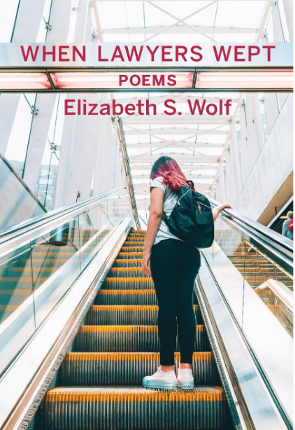
While I waited for Did You Know? to arrive (a long wait, between winning in April 2018 and publication summer 2019) I pulled together a full-length collection, When Lawyers Wept. The first section is the complete Did You Know? chapbook (yes with full permission!). The second half is new and previously published poems. It includes my first Pushcart nominated poem, which originally appeared in Ibbetson Street. Written just after the Kavanaugh hearings, it spilled out in mostly one take after reading a confession in the Washington Post from a man who witnessed a rape through the casement window at a football frat party and did nothing. It starts out:
Between My Fingers Like a Shield
I carry shards of glass
in my pockets. I broke the mirror.
I didn’t want to see.
Pretty gets catcalled.
Pretty gets groped by anonymous hands.
Men press against Pretty’s behind
on the bus. Pretty gets winks and told
to smile more. I don’t
wash my hair. I don’t
make up my face. My daddy
is afraid I like girls. But that’s not
the worst thing.
When Lawyers Wept is dear to my heart (don’t tell the other books I said that). Also, Kelsay Books has a fantastic cover designer. The image we chose is actually not my daughter but a dead ringer, on the escalator of the Government Center T stop, right outside where my father worked in the 1970s. It resonates on so many levels. The book only has one review on Amazon but all the stars: “…"When Lawyers Wept" is like a gripping autobiography of shocking sad events, out of which -- incredibly -- the poet finds strength and even humor. This is not like any collection of poetry I have ever read, I could NOT put it down. Highly recommended!” Thanks, Robin.
The end of 2019/ early 2020 was busy with readings and promotion. I had two new books. I had 4 events around Swansea, Wales as a guest of Swansea poets. I read at open mics and took workshops and then… COVID-19 hit and the world shut down.

I had a few cool projects during quarantine. By then my daughter was at Cornell and working with Prisoner Express. PE combats isolation by providing education and community through newsletters and programs serving incarcerated people nationwide. PE kept going through quarantine, as it runs via US mail. Her boss asked if she knew anything about poetry. They hadn’t done a poetry project in a while.
I joked for years that her inheritance would be 400+ copies of my Rattle chapbook. So she asked if I would consider donating to incarcerated poets. My first thought was no, there wouldn’t be much interest. The PE program skews male, and my best reviews did not. But we wrote a pitch for the PE newsletter and over 300 people signed up. That fall I donated 325 copies of Did You Know? along with 4 prompts for writing original chapbooks.
Over the next year, PE forwarded batches of handwritten chapbooks from prisons all over the country. I read them at the kitchen table and wrote letters to each author. I used post-its to tag poems in the beginning, middle, and end of each work, so the poets could tell from my comments I had read the whole thing. There were some truly stunning poems.

I reached out to Tim Green at Rattle to pitch the project for the Rattlecast podcast. Tim stepped up: Rattle had floated a feature on incarcerated poets but hadn’t received sufficient submissions. He asked if I had anything worth consideration. I quickly sent a dozen poems that I had typed up for the PE blog. Tim not only scheduled a PE feature, he agreed to read the poems as they were— largely handwritten. I copied every tagged page, submitting hundreds and hundreds of poems. Rattle #76, Summer 2022, featured a Tribute to Prisoner Express including 13 incarcerated poets.

Like everyone else, I was spending a lot of time online. An indie writer Susan Kaye Quinn, also a rocket scientist, scored space in the Commercial Lunar Payload Services (CLPS) Program to send data to the moon. Sue put out a call on Facebook for interested authors to join Writers on the Moon. Of course I applied. I was surprised when I was selected. And then momentarily stumped. I am not a sci-fi or speculative writer. The assignment was to curate a snapshot of stories to create a time capsule of humanity in 2021. No small task.
I decided to start where I was and move outward. My section includes my own work: my books, plus a poem that had just won a prize. Next my local community: a Merrimac Mic anthology. Next the global community: a bilingual anthology in English and Farsi. I added in the chapbook prompts sent out by Prisoner Express. So our readers on the moon, whoever they may be, can be inspired to write their own stories.

Writers On The Moon launched with the Peregrine lander from Astrobotic in 2024. Sadly there were problems and the lander returned to earth, burning up on re-entry. Space is hard. But! a copy of the archive will ride again on Griffin Mission 1, aiming for the Nobile Crater Region near the moon’s South Pole. Launch is tentatively scheduled for July 2026. In the meantime, several anthologies with some of my stories and poems are in the Lunar Codex, a project run by Dr. Samuel Peralta. The codex has successfully landed on the moon. More to that story here in a fascinating TEDx talk.
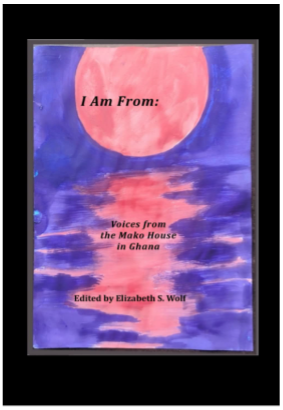
My only self-published project was a collaboration. After graduating college in 2021 my daughter spent much of the next 3 years working in the rural Volta region of Ghana, living in a boarding house with at-risk kids. On my first visit, I stayed in her village for a week. I shadowed her for a 24-hour day-in-the-life. We decided the main challenges facing the kids were literacy and lack of confidence. Her students started school late and were in classes with younger kids. Schools in Ghana use immersion to teach English, with native language instruction decreasing by grade. Her kids were embarrassed by their class assignment but stuck behind a language barrier. No one is at their best when they feel stupid.

I returned in February 2023 for nearly a month. A month without AC or hot running water or a shower, but with a teacher friend and a plan. We held 5 poetry workshops for 17 kids and house staff, using American, Ghanaian, and Nigerian poems as prompts. We gave each kid a notebook (a big deal; they previously shared paper and pencils) and a Rattle Young Poets Anthology. After each session we snapped an iPhone photo of their in-class poems. Our teacher typed them into a Google doc. We had an afternoon workshop inviting the kids to make art to accompany their stories. It was an amazing adventure.

I Am From
I am from Akplamafu
where wonderful farms are located.
I am from mud houses with thatch roofs.
I am from trees
Where trees smells like apples
And rivers flow with milk.
I am from a shed with bows and arrows
for hunting.
I am from a thick bush with heavy rainfalls.
— Edmund, age 10
Once home, our mighty Merrimac Mic editor helped prep the poems, art, and a dozen of my daughter’s photos into a manuscript for KDP. A month later we published I Am From: Voices from the Mako House in Ghana. The book is for sale on Amazon, with all proceeds supporting the Mako community.

We sent a big box of books back overseas. Every kid got a book in their hands, with their name in print, as a published author. We gave copies to their teachers and program supporters. The next year I was unable to travel to Hohoe. At Christmas some of the kids sent me poems and drawings. Priceless.

I had one more project that year. Back in 2020 I joined the Scheherazade Project #101 Nights, spearheaded by Julia Alvarez (Facebook following favorite authors has perks!). Originally they planned nightly performances in DC, counting down to the presidential election. That didn’t happen. But by 2023 we could travel. The Scheherazade Project invited us to tape performances at the Supreme Court, US Capitol, and the White House. I signed up for a slot with an intern to film. On a hot day in late July, we made it to all 3 venues.
Congress was rushing to shut down for August recess, but I had a side quest. I brought copies of I Am From and American Graveyard, a call to end gun violence to the offices of AOC and Maxwell Frost. Didn’t get to meet them, sadly. But they have lovely staff. I walked through the members-only underground tunnels and totally geeked out.

My latest book came out from Kelsay in Dec 2025. Parenting in the Age of Columbine started with a prompt to write a braided poem. While struggling to come up with a topic the opening line leapt to mind: “My daughter was born the week after Columbine.”
This book is a braided collection. Each triplet includes a shooting incident; a personal slice of life; and a quote from an external source, such as Dr. Spock’s Baby and Child Care. In the tradition of "the personal is political," my intention is to show how school shootings have shaped our lives and the way we move in the world.

The anchor poem April 1999 was a finalist for the Joy Harjo Poetry Prize in 2022. The video edition featured at the Poetry in Motion Festival in Colorado in 2024. The poem starts:
My daughter was born the week after Columbine.
My daughter was born new
coated in vernix, raw, startling:
a gift, a challenge, a chance
for a major do-over.
Trust yourself.
You know more than you think you do.
(Dr. Spock’s Baby and Child Care, 7th Edition, 1998, p1)
My daughter was 13 and an intern at an After School program during the Sandy Hook shooting. She was 18 and overseas on a gap year during Parkland. I read poems from the Parkland section of the book at the AWP events, including a haibun with the ending haiku:
freckle-faced boys
with AR-15s
American as apple pie
Parenting in the Age of Columbine took over two years to complete. I did a lot of research. The back matter includes pages of notes, readings, and resources. Thanks to Jennifer Martelli, a sorely missed poet from Salem, for teaching me about docupoetry.

Where do I go from here? I confess, I never know. My current work-in-progress is a novel in verse, my first foray into actual fiction. Sometimes I love it and other times I’m ready to toss it in the trash. But as long as I can, I’ll keep writing. To try to make sense of this crazy world. To keep the voices in my head engaged in a creative task. Because now that I’ve retired, this is my full-time job. And some days it goes really, really well.
VISIT: ElizabethSWolf
READ: It’s Complicated
WATCH: Sage Creators Collective: Wild Debut
LISTEN: Prisoner Express Rattlecast #156
ENTER TO WIN AN AUTOGRAPHED COPY OF PARENTING IN THE AGE OF COLUMBINE
Send an email with the subject "Elizabeth S Wolf Book" to bostonliterarymagazine@gmail.com
YOUR ADDRESS WILL NOT BE SHARED WITH ANYONE AND WILL ONLY
BE USED FOR THE DURATION OF THIS APRIL ISSUE ENTRY PERIOD


Comments